Wednesday, 16 February 2011
Moot Creator of the DarkSide of Social Media
Christopher "moot" Poole: The case for anonymity online | Video on TED.com
Moot "Christopher Poole" was the creator and founder of 4chan. 4chan is a anonymous community who have show what the true power of the internet can be if people work together for a common idea. 4chan has also be criticized as being the cesspool of the internet as anything goes and anything is created. It has also been one of the main area's where internet meme's have been created.

Monday, 7 February 2011
FLOSS other than Software,
The Floss/foss ethics have been used in other area's other than software, Open Organization is a good example of this. Open Organization is a framework set-up by a group of individuals that set out rules and guide lines on how an organization can function. With the goal to have this organization to be open and transparent at all levels and also be accountable for it's actions. This idea of how an organization can run goes agents the original idea on how an organization works, with it's decision-making are closed, with individuals are unaccountable, and abuses of power are hard to prevent with the knowledge used and produced are hoarded.
With the open organization being set-up differently from the usual. With the ideal use of this new structure being used at every level from government and corporations to activist and volunteer groups. This old system usually have a small group of people with control and power over everyone else with the other members just doing what they are told. Open Organization on the other hand want to remove at some level the small group of people with all the controls and give it to the majority specially in decision-making and how the people use there time. With the decision-making being done by group consensus, so that everyone has a chance of speaking and participating in the discussion. Open Organization also promotes the idea of a charter or something similar, this is a documents that lays out the organizations goals and ideas. This allows any one at any point to challenge the organization and make sure that it is true to it original goals. Through group discussions the charter maybe changed or a smaller group with it's own charter be formed to deal with a certain idea or problem. This allows the organization to constantly change and advance to it's goals. ( Open Organization Decision-making guide)
Open Organization also promotes that the organization to publish in some form all of it's documents and discussions in away that anyone can have access to them and view them. This idea of being transparent is a fundamental part of the organization of this group. It allows group members to be aware of what has been done or going to be done. It also allows the group to be accountable for it's action by the group or anyone out side the group.
Another way of using Open Organization is to use it as a referees when looking at other organizational structures. This way of using Open Organization allows the user to critique the other and hopefully find improvements in the original structure or Open Organization itself. As Open Organization run by it's own guide lines, anyone can make suggestions to framework and discuss them with the group.
Home page for Open Organization.
With the open organization being set-up differently from the usual. With the ideal use of this new structure being used at every level from government and corporations to activist and volunteer groups. This old system usually have a small group of people with control and power over everyone else with the other members just doing what they are told. Open Organization on the other hand want to remove at some level the small group of people with all the controls and give it to the majority specially in decision-making and how the people use there time. With the decision-making being done by group consensus, so that everyone has a chance of speaking and participating in the discussion. Open Organization also promotes the idea of a charter or something similar, this is a documents that lays out the organizations goals and ideas. This allows any one at any point to challenge the organization and make sure that it is true to it original goals. Through group discussions the charter maybe changed or a smaller group with it's own charter be formed to deal with a certain idea or problem. This allows the organization to constantly change and advance to it's goals. ( Open Organization Decision-making guide)
Open Organization also promotes that the organization to publish in some form all of it's documents and discussions in away that anyone can have access to them and view them. This idea of being transparent is a fundamental part of the organization of this group. It allows group members to be aware of what has been done or going to be done. It also allows the group to be accountable for it's action by the group or anyone out side the group.
Another way of using Open Organization is to use it as a referees when looking at other organizational structures. This way of using Open Organization allows the user to critique the other and hopefully find improvements in the original structure or Open Organization itself. As Open Organization run by it's own guide lines, anyone can make suggestions to framework and discuss them with the group.
Home page for Open Organization.
Diva 200 - Urban Intervention Mockup
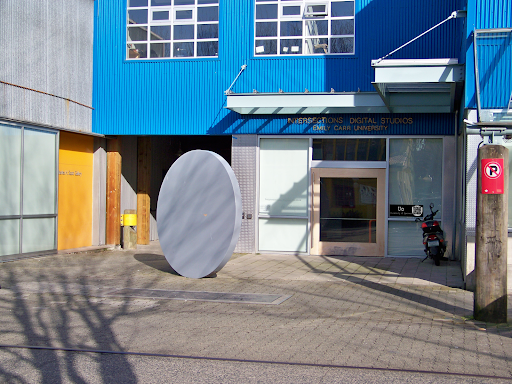
This is the location with the work places, it is a computer mock-up made on GIMP.

This is a copy of what the intervention will say and be like. This design was made using Inkscape.
This banner is a physical link to an online organization called University of Openness (Uo). The QRcode on the banner is a tinyurl link to the Uo about page with their charter link on this page as well. This organization has not had much activities in the recent years, but I believe that in our current situation with student finances and the question on what education should achieve. This organization should have greater interest.
Thursday, 3 February 2011
Diva 200 - Parama Final
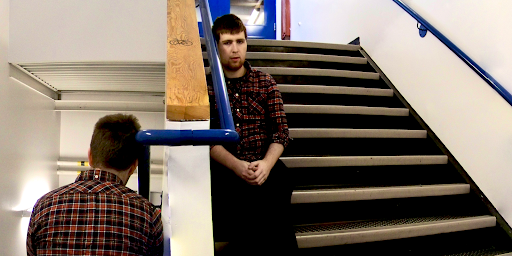
“Limbo”, 2011, Digital Photography
This work is trying to represent ideas of limbo and uncertainties with in the artist's current situation. This situation in which the artist has found himself in, has comes from the fact that he has been take out of a familiar location and educational system; then places into a new one. This miss placement has caused this uncertainty while he is settling into this new environment. This situation has been made more complicated as there are still important attachments which places him in his previous location and time, through friends, family and institutional commitments.
In the work the placing of the character twist adds a tension to the piece, with this tension showing the passage of time and situation. The work called “Picture for Women” by Jeff Wall in 1979, has a similar tension. With the method of capture describes a passage of time by the use of the mirror. The composition of the two images have several similarities, they both show two bodies at the same distance from the centre. The space in both of these images are spars area's which have clear lines breaking the whole shape, in “limbo” the hand rails create a different structure and method or exploring the image, while “Picture for Women” has the lights and the suggestion of a non-rectangular room gives a different dimension to the pieces.
Picture for Women by Jeff Wall 1979
http://www.tate.org.uk/modern/exhibitions/jeffwall/image/roomguide/rm1_picture_for_woman_lrg.jpg
Wednesday, 2 February 2011
Why Floss/foss

I though it would be best if I go through why I believe floss/foss ethics are important. Technology is ubiquitous in our world, where every part of our life has been digitised or implanted with technology to some degree. These technologies are usually under strong restrictions by their original manufactures by the us of warranties, patents and bespoke software and hardware controls. These features are in the technology to stop the user from having full control over their technology, with the user eventually being controlled by the device or being a controlled aspect of the design.
Proprietary software have been copyrighted and patented so that if you like a piece of software and you know someone could benefit from it, you aren't allowed to give them a copy. This idea of protection of the software for the sack of the corporation goes against an important aspect of computers, of the copy. The copy was one of the most important feature in which it allowing us to develop better technologies and to spread of knowledge. Proprietary software also denies you access to the source code so you can't fix problems and modify it to suit your needs better, it becomes a point of making do with what is given to you. Richard Stallman (rms) found this a problem in 1980 when he had problems with a printer which always jammed and he wasn't able to fix it due to the closed source. In 1985 rms produced the GNU manifesto (http://www.gnu.org/gnu/manifesto.html) in response to this problem of proprietary software. GNU is based around the idea of the golden rule, which is “that if I like a program I must share it with other people who like it”.
In creating the GNU the “Free Software Foundation” was also formed to advocates for free software ideals as outlined in the Free Software Definition. Which is Free software is a matter of the users' freedom to run, copy, distribute, study, change and improve the software. More precisely, it means that the program's users have the four essential freedoms:
Freedom 0: The freedom to run the program, for any purpose.
Freedom 1:The freedom to study how the program works, and change it to make it do what you wish. Access to the source code is a precondition for this.
Freedom 2: The freedom to redistribute copies so you can help your neighbour.
Freedom 3: The freedom to distribute copies of your modified versions to others.
By doing this you can give the whole community a chance to benefit from your changes. Access to the source code is a precondition for this.
In our connective world, we need to set up standards and rules that allow us to communicate between different area's of the world. Like http and tcp, these protocols allow the internet to work. This standards need to be open and freely available so that people on the networks are able to communicate with one another easily and with no problem of miscommunication. If these standards where proprietary then there would be strong restrictions over how and who can use them, it would also lead to communication problems. When you use a document format like doc or pdf you expect to be able to use the file on any computer with out a problem. If these formats where not open standards then you would have problems or even not be able to access these file's data from different computers, specially if they don't have the same system set.
Our ubiquitous world relies and has been created around the Floss/Foss ethics even before they where defined. So the idea of restricting our access to how these technologies work at any level could damage our relationship with these technologies. The art group “Critical Art Ensemble”(CAE) describes this act of restriction in one of their essays, they said “The corporate futurologists talk of evolution, revolution, new horizons and global vision. Well, their global vision is blinding me. My computer has a program that counts my keystrokes. It watches me all the time, and tells me when I am not working hard enough. It's like the computer is my boss. Every time I leave my computer, I return to find a message “insufficient data entry” posted on the screen. What's really frightening is that I've actually begun to care. I hesitate to leave my workstation for any reason. I question, and even ignore, my own needs and desires, and instead concern myself with the demands of my computer.”
GNU Manifesto http://www.gnu.org/gnu/manifesto.html
Free Software Definition http://www.gnu.org/philosophy/free-sw.html
Free Software Foundation http://www.fsf.org/
Critical Art Ensemble, 1996. Tactical Media. In: Alberro, A., 2009. Institutional Critique : an anthology of artists' writings, Cambridge Mass.: MIT Press. Pp 432-439
Thursday, 13 January 2011
Intrinsic Motivation
All aspects of the Internet and the modern world is in a process of changing it's motivational. This motivational is in the process of change from a monetary motivation to intrinsic motivation. The original idea of how to motivate people was you increase the incentives and rewards and it will produce a greater out come and a more desirable out come. The idea of the carrot and the donkey, where the donkey only does something when it is bated. Through research at several respected universities e.g. MIT, have found that is doesn't always happen the way expected.
In a test where they got a group of people to preform a high cognitive task and give 1/3 of the group a small monetary incentive the next 1/3 a medium monetary incentive and the last 1/3 a large monetary incentive. They found that the group who had the smallest incentive produced the best out come and the group of people who had the greatest incentive produced the worse outcome. In further research they found out that if a task is above a low cognitive task the motivation of the person is different, the persons motivation is driven by autonomy, mastery and purpose.
The communities based around the Internet and Floss/foss are all based around intrinsic motivation. For where the individuals goal is to master new skill or to help out other people. A project which shows this is the openstreetmap. This is a global map which is completely generated by user's uploading and drawing the map features onto the system. During the Haiti disaster this community map was the most accurate map available which developed and changed as the situation changed on the ground, all because of the community around the world wanted to help. This helping was only possible because of different companies releasing data they had, on an open license. This data involved real time satellite images to up-to date disaster information. These factors made the openstreetmap of the country the most accurate map Haiti has ever had and is still being use by the country as their main map source. In the disaster it was also used by all the aid works on the ground because of the same reasons.
This is a video of the reaction on openstreetmap after the Haiti disaster, with every flash being the creation of a map object.
Pink, D,. 2010. RSA Animate - Drive: The surprising truth about what motivates us, Available at: http://www.youtube.com/watchv=u6XAPnuFjJc&feature=youtube_gdata_player [Accessed November 15, 2010]
Tim Berners-Lee: The year open data went worldwide|Video on TED.com. Available at: http://www.ted.com/talks/lang/eng/tim_berners_lee_the_year_open_data_ went_worldwide.html [Accessed November 15, 2010].
In a test where they got a group of people to preform a high cognitive task and give 1/3 of the group a small monetary incentive the next 1/3 a medium monetary incentive and the last 1/3 a large monetary incentive. They found that the group who had the smallest incentive produced the best out come and the group of people who had the greatest incentive produced the worse outcome. In further research they found out that if a task is above a low cognitive task the motivation of the person is different, the persons motivation is driven by autonomy, mastery and purpose.
The communities based around the Internet and Floss/foss are all based around intrinsic motivation. For where the individuals goal is to master new skill or to help out other people. A project which shows this is the openstreetmap. This is a global map which is completely generated by user's uploading and drawing the map features onto the system. During the Haiti disaster this community map was the most accurate map available which developed and changed as the situation changed on the ground, all because of the community around the world wanted to help. This helping was only possible because of different companies releasing data they had, on an open license. This data involved real time satellite images to up-to date disaster information. These factors made the openstreetmap of the country the most accurate map Haiti has ever had and is still being use by the country as their main map source. In the disaster it was also used by all the aid works on the ground because of the same reasons.
This is a video of the reaction on openstreetmap after the Haiti disaster, with every flash being the creation of a map object.
OpenStreetMap - Project Haiti from ItoWorld on Vimeo.
Pink, D,. 2010. RSA Animate - Drive: The surprising truth about what motivates us, Available at: http://www.youtube.com/watchv=u6XAPnuFjJc&feature=youtube_gdata_player [Accessed November 15, 2010]
Tim Berners-Lee: The year open data went worldwide|Video on TED.com. Available at: http://www.ted.com/talks/lang/eng/tim_berners_lee_the_year_open_data_ went_worldwide.html [Accessed November 15, 2010].
Wednesday, 12 January 2011
Social Sphere DIVA200
After the lesson I saw this on TEDtalks. It covers some of the idea's that where talked about during the lesson where interesting specially about our public space, social sphere area.
This is Amber Case: We are all cyborgs now TEDtalk goo.gl/H8Ejg
This is Amber Case: We are all cyborgs now TEDtalk goo.gl/H8Ejg
Subscribe to:
Posts (Atom)